Hardware for Signed-Magnitude Addition & Subtraction
Understanding Digital Arithmetic Operations in Computer Systems
📚 Introduction
In digital systems, arithmetic operations such as addition and subtraction are fundamental. The hardware implementation of these operations requires special handling when dealing with signed numbers (positive and negative values).
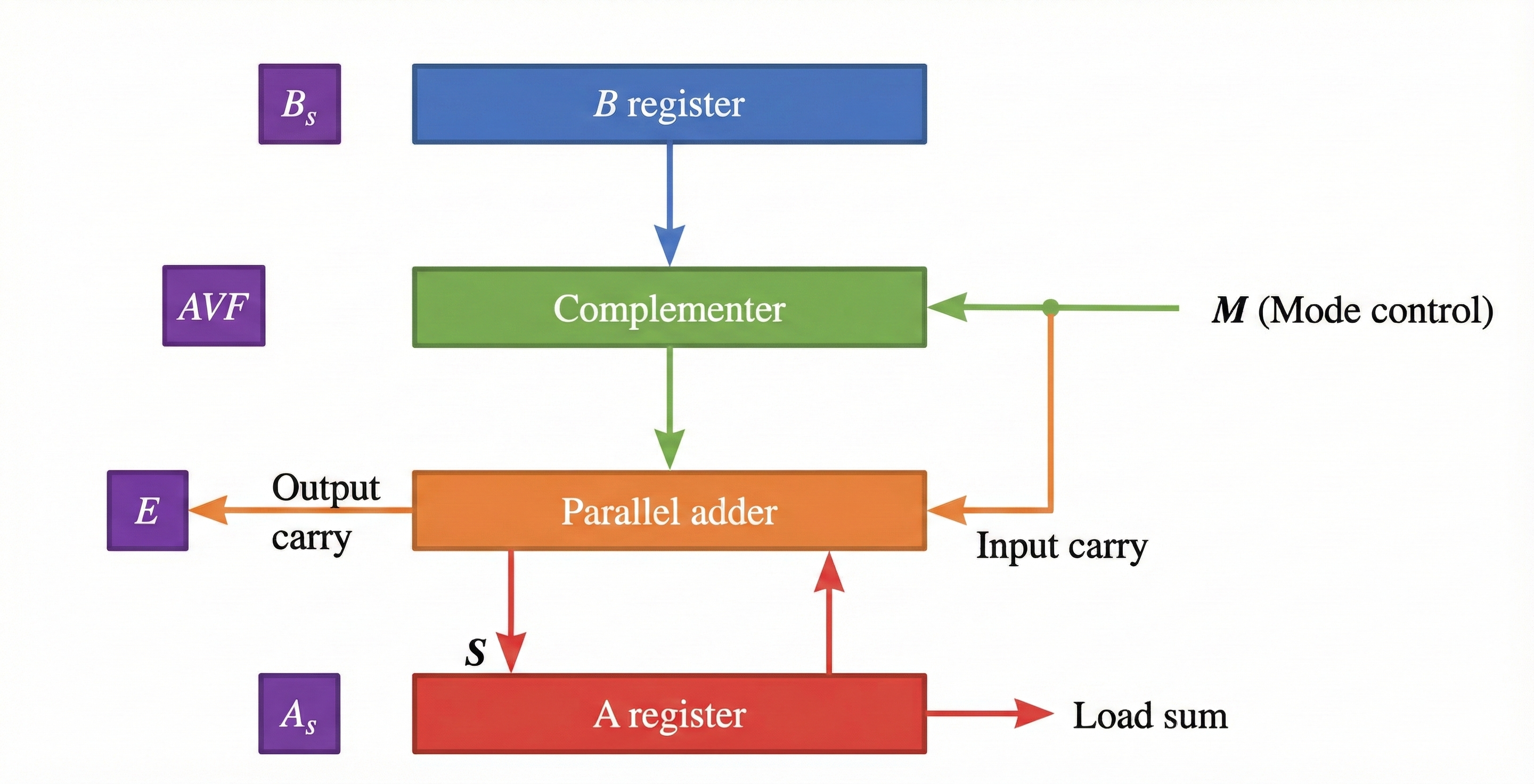
The hardware efficiently performs operations by utilizing registers, adders, complementers, and control logic to decide between addition and subtraction.
🔧 Hardware
📦 Registers (A & B)
Store the magnitudes of operands. Register A holds one operand while Register B holds the second operand.
🔀 Sign Flip-Flops
Store sign bits (As, Bs) where 0 = positive and 1 = negative. Essential for determining operation type.
🔄 Complementer
Forms the 2's complement of Register B. Controlled by mode signal M (M=0: pass through, M=1: complement).
➕ Parallel Adder
Adds contents of Register A and (possibly complemented) Register B, producing the sum S.
📤 Output Carry (E)
Holds carry-out from addition. Used for comparison and overflow detection.
⚠️ Overflow Flip-Flop
AVF stores overflow bit when A and B are added, helping detect arithmetic overflow conditions.
⚙️ Working Principle
Addition Mode (M = 0)
- ✓ Complementer passes B directly to the adder
- ✓ Input carry is set to 0
- ✓ Adder computes: S = A + B
- ✓ Result stored back in Register A
- ✓ AVF flip-flop holds overflow information
🎯 Interactive Calculator
💡 Example Operations
Example 1: Addition (M = 0)
Input A = 0101 (5), B = 0011 (3)
Result 1000 (8) stored in Register A
Example 2: Subtraction (M = 1)
Input A = 0101 (5), B = 0011 (3)
Step 2: Add carry = 1 → 1101 (2's complement)
Step 3: 0101 + 1101 = 10010
Result 0010 (2), carry ignored. A - B = 2
✨ Design Advantages
- 🔹 Efficient hardware utilization – Only one adder and one complementer required
- 🔹 Dual functionality – Handles both addition and subtraction using same circuitry
- 🔹 Overflow detection – Built-in through AVF flip-flop
- 🔹 Comparison capability – Output carry indicates magnitude relationship (A ≥ B or A < B)
📝 Summary
The hardware efficiently performs signed-magnitude addition and subtraction through the coordinated use of:
- ✓ Registers for operand storage
- ✓ Complementer for 2's complement operations
- ✓ Parallel adder for arithmetic calculations
- ✓ Flip-flops for sign, overflow, and carry detection
💡 Key Takeaway: This setup forms the foundation of computer arithmetic, illustrating how operations in a CPU or ALU are structured in modern digital systems.