⚡ Hardware Algorithm
Interactive Guide to Signed Addition & Subtraction
🎮 Try It Yourself!
🔧 Core Components
📊 Algorithm Flowchart
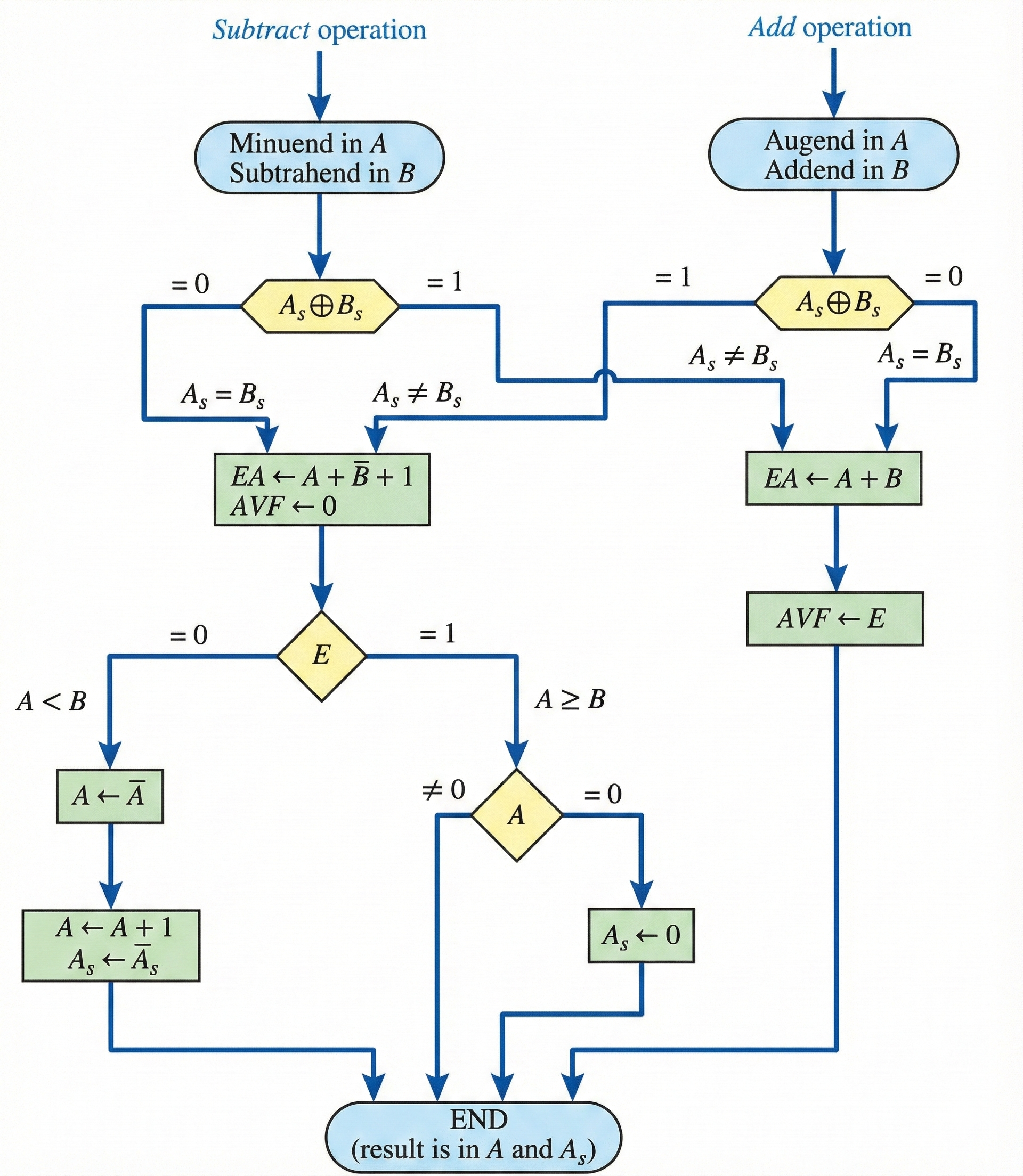
🎯 Algorithm Logic
The algorithm uses XOR operation on signs:
Result = 0: Signs are identical (both + or both -)
Result = 1: Signs are different (one +, one -)
ADD Operation
• Same signs → Add magnitudes, check overflow
• Different signs → Subtract magnitudes (redirect to subtraction logic)
SUBTRACT Operation
• Different signs → Add magnitudes (treat as addition)
• Same signs → Subtract magnitudes using 2's complement
➕ Addition Process
When Signs are Identical
✓ Add the magnitudes directly
✓ Store sum in register A
✓ Carry-out goes to E flip-flop
✓ Check overflow: AVF ← E
✓ Result sign = original sign (As)
➖ Subtraction Process
When Signs are Identical
✓ Use 2's complement: complement B, add 1
✓ Add to A
✓ AVF ← 0 (no overflow in subtraction)
✓ Check carry bit E:
• Result in A is correct
• Sign stays as As
• If A = 0, force sign to positive (+0)
• Result is 2's complement of true answer
• Take 2's complement: A ← A' + 1
• Flip sign: As ← As'