Booth Multiplication Algorithm
Efficient Binary Multiplication for Signed Numbers
📚 Overview
The Booth Multiplication Algorithm is a powerful technique for multiplying binary numbers, particularly efficient for signed binary multiplication. Developed by Andrew Donald Booth in 1950, it reduces the number of additions required in the multiplication process by examining consecutive bits and performing intelligent operations.
⚡ Efficient
Reduces the number of arithmetic operations compared to traditional methods
🔢 Handles Signed Numbers
Works seamlessly with both positive and negative binary numbers
🎯 Hardware Implementation
Easily implemented in digital circuits and processors
🎛️ Navigation
Algorithm Steps
- If QnQn+1 = 01: AC ← AC + BR (Add multiplicand to AC)
- If QnQn+1 = 10: AC ← AC - BR (Subtract multiplicand from AC)
- If QnQn+1 = 00 or 11: Do nothing
Worked Example: B = 10111 (Multiplicand)
This example demonstrates the complete multiplication process using Booth's Algorithm:
| Operation | E | A | Q | SC |
|---|---|---|---|---|
| Multiplier in Q | 0 | 00000 | 10011 | 101 |
| Qn = 1; add B | 10111 | |||
| First partial product | 0 | 10111 | ||
| Shift right EAQ | 0 | 01011 | 11001 | 100 |
| Qn = 1; add B | 10111 | |||
| Second partial product | 1 | 00010 | ||
| Shift right EAQ | 0 | 10001 | 01100 | 011 |
| Qn = 0; shift right EAQ | 0 | 01000 | 10110 | 010 |
| Qn = 0; shift right EAQ | 0 | 00100 | 01011 | 001 |
| Qn = 1; add B | 10111 | |||
| Fifth partial product | 0 | 11011 | ||
| Shift right EAQ | 0 | 01101 | 10101 | 000 |
| Final product in AQ = 0110110101 | ||||
Hardware Architecture
Component Description:
- BR (B Register): Holds the multiplicand
- AC (Accumulator): Stores partial products during computation
- QR (Q Register): Holds the multiplier and evolving product
- SC (Sequence Counter): Tracks the number of iterations remaining
- Complementer & Adder: Performs addition/subtraction operations
Algorithm Flowchart
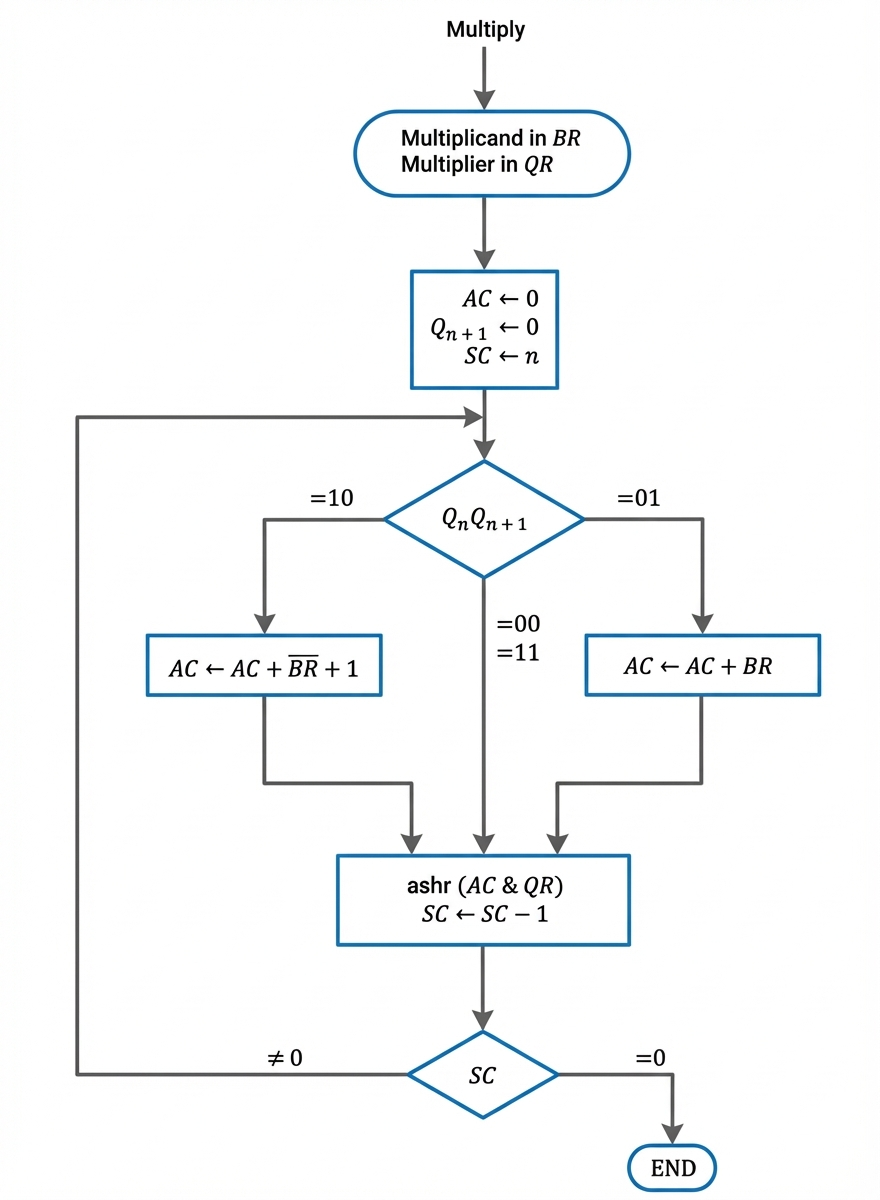
Flowchart Key Points:
- Initialization: Sets up registers and counters for the algorithm
- Bit Pair Examination: Checks QₙQₙ₊₁ to determine the operation
- Conditional Operations: Add, subtract, or do nothing based on bit pattern
- Arithmetic Shift: Right-shifts the result while preserving the sign
- Loop Control: Continues until all bits are processed (SC = 0)
Interactive Booth Multiplication Calculator
Enter binary numbers to see Booth's algorithm in action! (Use 5-bit signed binary numbers)
🎯 Advantages of Booth's Algorithm
✓ Efficiency
Reduces the number of additions needed, especially when multiplying numbers with consecutive 1s or 0s
✓ Signed Arithmetic
Naturally handles two's complement signed numbers without additional conversion
✓ Hardware Friendly
Simple to implement in digital circuits with standard components
🔍 Why Booth's Algorithm Works
The algorithm exploits the mathematical property that a string of 1s in binary can be represented as a subtraction. For example:
Binary: 0111 = 8 - 1 = 7
This means: 0111 = 1000 - 0001
By recognizing bit patterns (01 and 10 transitions), Booth's algorithm minimizes operations by treating consecutive 1s as a single subtract-add pair rather than multiple additions.