Definition and Purpose
Parallel processing is a computing technique where multiple calculations or processes are carried out simultaneously.
This approach aims to significantly improve the speed and efficiency of executing tasks. It is particularly effective for complex problems that can be broken down into smaller, independent parts.
Challenges in Parallel Processing
While parallel processing leads to significant performance improvements, it also introduces several challenges:
- Synchronization between processes
- Managing shared resources
- Ensuring that tasks are divided and coordinated effectively
Processor Organization with Multiple Functional Units
A system designed for parallel execution may feature a processor with multiple functional units. This architecture includes processor registers whose output is routed to various specialized units.
Processor with Multiple Functional Units
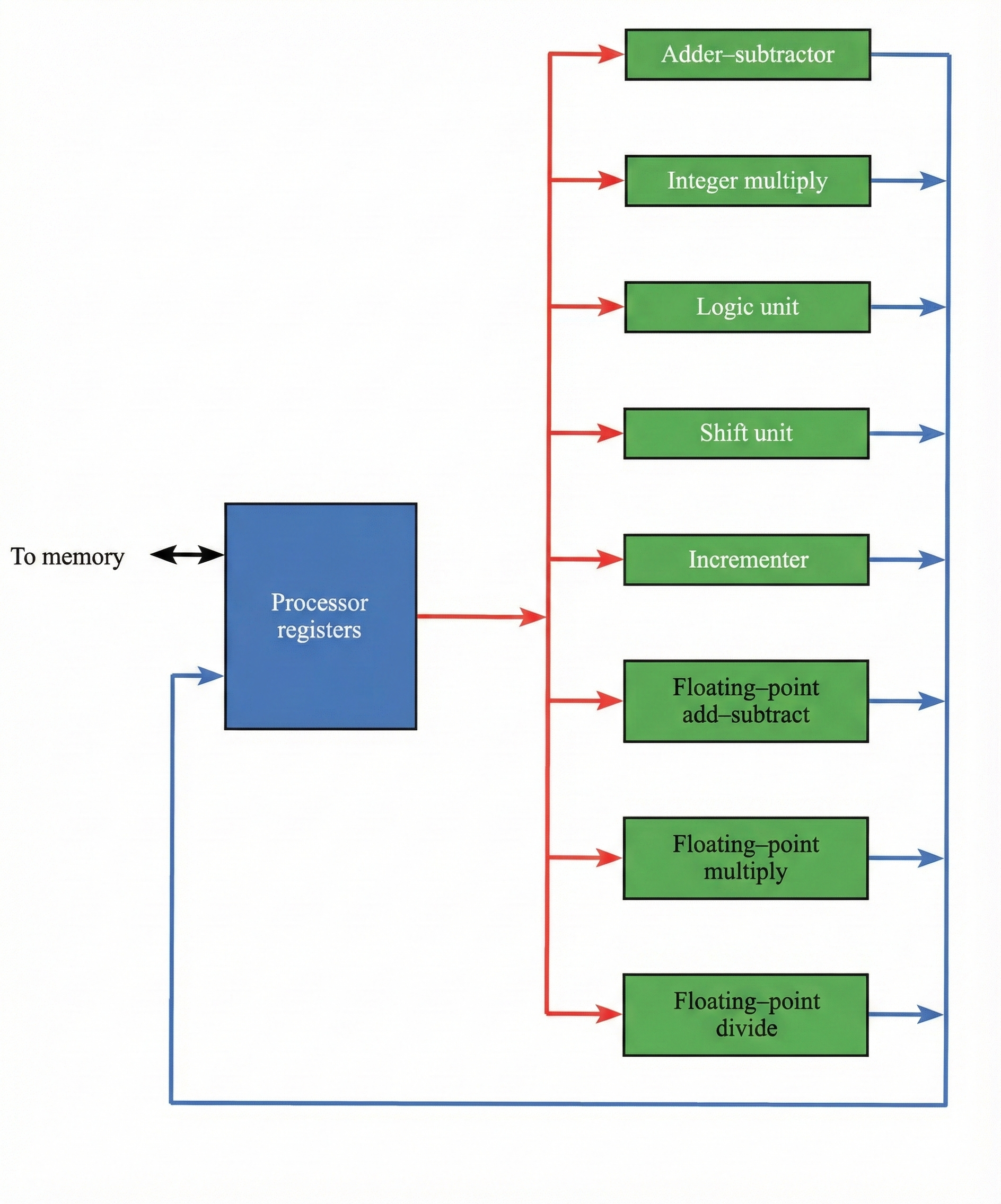
Functional Units
The results from these functional units typically loop back to the processor registers.
Classification of Parallel Processing (Flynn's Taxonomy)
Parallel processing systems can be classified in various ways. One widely recognized way to consider the organization of a computer system is by the number of instructions and data items manipulated simultaneously, as proposed by M. J. Flynn.
The fundamental sequence of operation is to fetch an instruction from memory and execute it.
Key concepts:
- Instruction Stream: The sequence of instructions fetched from memory
- Data Stream: The operations performed on the data within the processor
Parallel processing can occur in the instruction stream, in the data stream, or both.
Flynn's Four Categories
Traditional sequential processor executing one instruction on one data element at a time.
Same instruction executed on multiple data elements simultaneously. Vector processing follows this principle.
Multiple instructions operate on the same data stream. Rare in practice.
Multiple processors execute different instructions on different data independently.
Interactive Challenge
Test your understanding of parallel processing concepts!