🖥️ Interrupt Program
Understanding Programmed I/O & Interrupt Cycles
📋 What is Program Interrupt?
Program interrupt is a method of programmed control transfer where the computer continuously checks the flag bit for input-output device readiness.
Key Feature: The computer can process other tasks while waiting for I/O device readiness, periodically checking the flag bit.
⚡ Transfer Rates
Slow Transfer: When flag bit = 1, transfer occurs at maximum 10 characters/second.
Fast Transfer: Computer processes information at much higher rates.
This speed difference allows the computer to handle other tasks between transfers.
🎯 Interrupt Control
The interrupt flip-flop IEN can be set and cleared with two instructions:
- ION: Set IEN to 1 (enable interrupts)
- IOF: Clear IEN to 0 (disable interrupts)
🔄 Interactive Interrupt Cycle
Interrupt Handling Flow
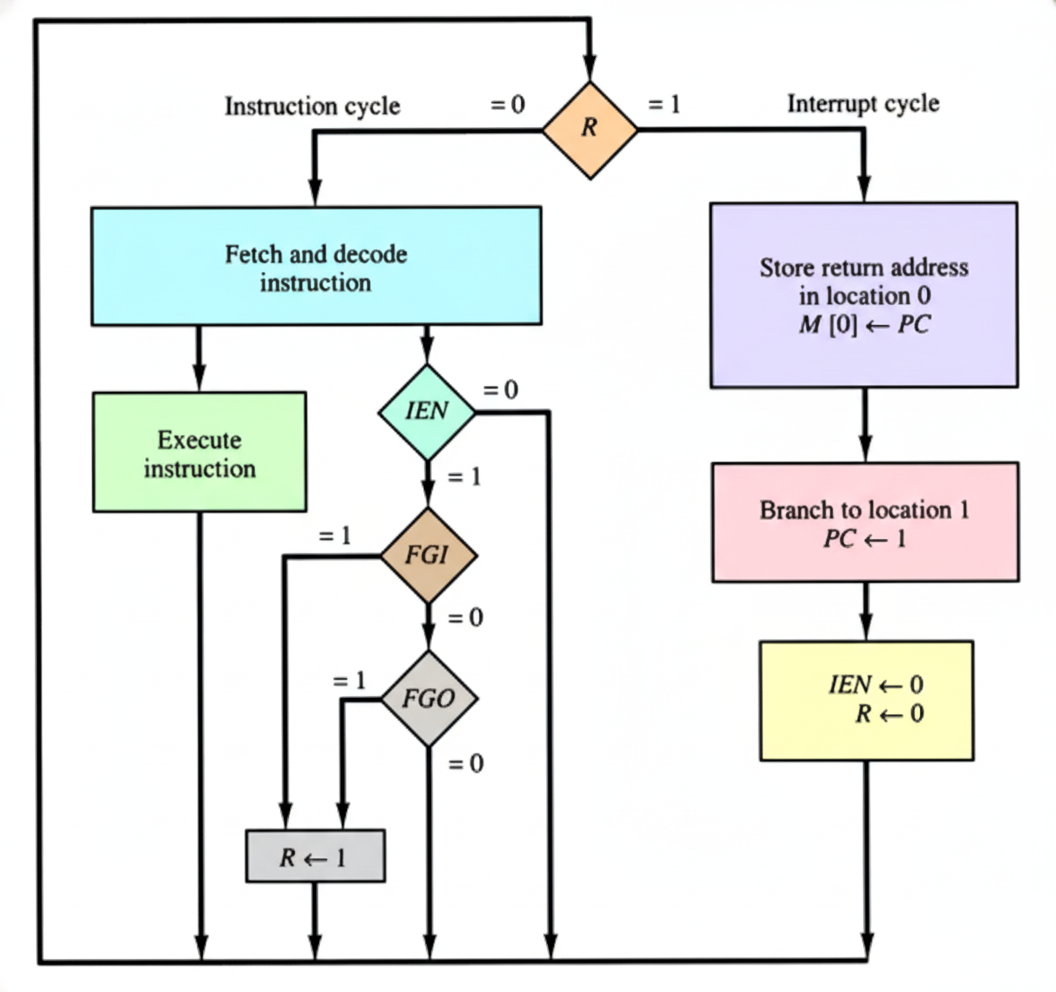
Interrupt Cycle Process
The interrupt cycle is triggered after the execute phase when R = 1, IEN = 1, and the flag bit is set.
🔄 What Happens During Interrupt?
- Store Context: Return address is saved to location 0
- Branch to Handler: Program jumps to interrupt service routine at location 1
- Clear Flags: IEN = 0 and R = 0
- Process Interrupt: Execute service routine
- Return: Use indirect branch to resume main program
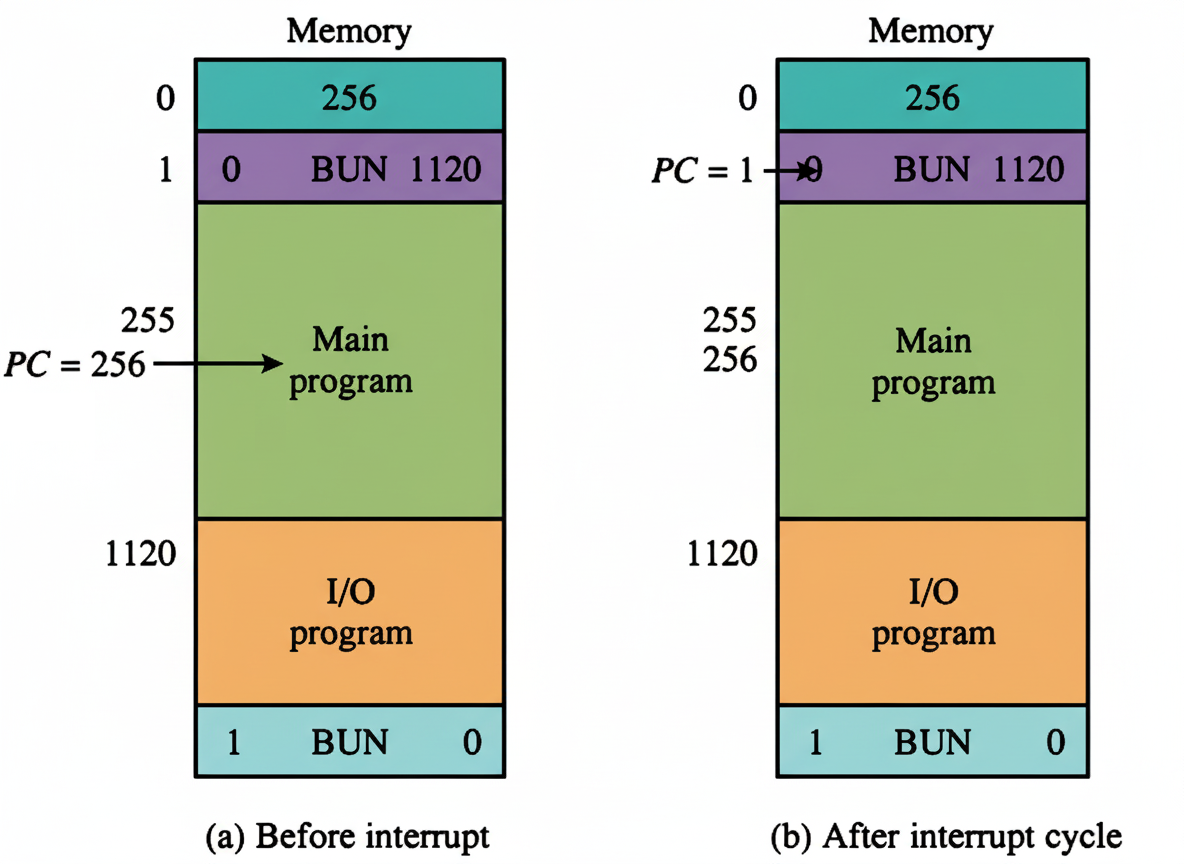
Example: Address 255 executing any instruction
Interrupt occurs → PC = 256
After interrupt cycle:
- Return address 256 stored in location 0
- IEN and R cleared to 0
- Program jumps to location 1, execute service routine
Interrupt occurs → PC = 256
After interrupt cycle:
- Return address 256 stored in location 0
- IEN and R cleared to 0
- Program jumps to location 1, execute service routine
Register Transfer Statements
The interrupt cycle involves the following sequence of operations:
Timing Signals and Operations:
T₀'T₁'T₂'(IEN)(FGO + FGI): R ← 1
First Timing Signal (R = 1, T₀):
RT₀: AR ← 0, TR ← PC
Second Timing Signal (R = 1, T₁):
RT₁: M[AR] ← TR, PC ← 0
Third Timing Signal (R = 1, T₂):
RT₂: PC ← PC + 1, IEN ← 0, R ← 0, SC ← 0
First Timing Signal (R = 1, T₀):
RT₀: AR ← 0, TR ← PC
Second Timing Signal (R = 1, T₁):
RT₁: M[AR] ← TR, PC ← 0
Third Timing Signal (R = 1, T₂):
RT₂: PC ← PC + 1, IEN ← 0, R ← 0, SC ← 0
Explanation:
- T₀: Transfer PC to TR, set AR to 0
- T₁: Store return address in memory location 0, clear PC
- T₂: Increment PC to 1, disable interrupts, return to instruction cycle
💡 Key Point: The control goes through fetch phase with PC=0, then indirect phase to read effective address from location 0, jumping to the interrupt service routine.
🎓 Summary
Program interrupt provides an efficient mechanism for handling I/O operations by:
- Allowing CPU to work on other tasks while waiting for I/O
- Automatically saving program context when interrupt occurs
- Branching to service routines to handle I/O operations
- Returning control to the interrupted program seamlessly