🔢 Floating-Point Register Configuration

Understanding Register Architecture for Floating-Point Operations

📋 Overview

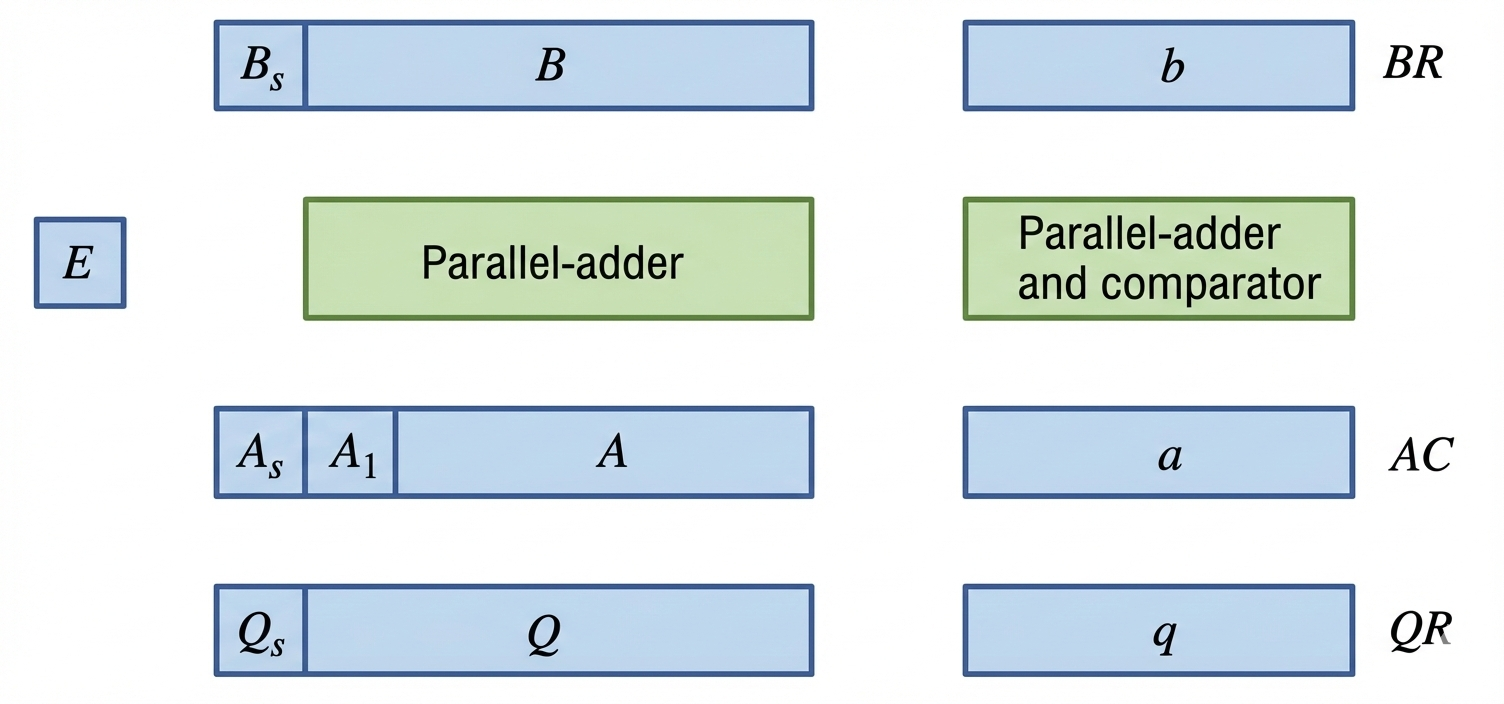
The register configuration for floating-point operations shares similarities with fixed-point operations, but uses a general rule: mantissa adders process the mantissas, while exponent adders handle the exponents.

The key difference lies in how operations are split between mantissa and exponent processing, with separate hardware units for each component.

Registers for Floating-Point Arithmetic Operations
Signed Division Flowchart

🔤 Register Organization

The register structure follows a pattern where mantissas use uppercase letter symbols and exponents use corresponding lowercase letter symbols:

  • BR (B Register): Subdivided into Bs, B, and b. Also includes QR components Qs, Q, and q
  • AC (Accumulator): Contains mantissa part (A) and exponent (a) with sign bits
  • E Register: Flag to represent output carry of Parallel adder
  • Parallel-adder: Separate units for mantissas and exponents

⚙️ Key Characteristics

  • Mantissa sign: Stored in As, represented as a signed-magnitude number
  • Exponent representation: Uses biased positive quantity
  • Exponent handling: Overflow is very rare and therefore neglected
  • Magnitude detection: The number in mantissa will be taken as a fraction, so The Binary Point (radix point) is conceptually fixed immediately to the left of the magnitude part.
  • Normalization: To normalize, the system shifts the mantissa to the left (and decrements the exponent) until the first bit becomes a 1.

🔄 Processing Flow

Numbers in registers are initially normalized and remain normalized through operations. The system ensures that:

  • Multiplication and division require special scaling for the integer part
  • Parallel-adder processes mantissas while separate adder handles exponents
  • Operations maintain normalization from input to output
Addition Subtraction