📐 Division Algorithms
Understanding Hardware Implementation of Binary Division
Introduction to Division Algorithms
Division is one of the fundamental arithmetic operations in digital systems. Unlike addition and subtraction, division is more complex and requires multiple iterative steps to complete. This section explores how binary division is implemented in digital hardware.
Key Concepts
- Dividend (A): The number being divided
- Divisor (B): The number by which we divide
- Quotient (Q): The result of the division
- Remainder: What remains after division
Division Process
Binary division follows a similar process to decimal long division, but operates on binary digits. The basic steps involve:
- Compare the divisor with the current portion of the dividend
- If dividend portion ≥ divisor, subtract and record 1 in quotient
- If dividend portion < divisor, record 0 in quotient
- Shift and repeat until all bits are processed
Divisor:                    11010        Quotient = Q
B = 10001              ⟌0111000000      Dividend = A
                        01110           5 bits of A < B, quotient has 5 bits
                        011100          6 bits of A > B
                        -10001          Shift right B and subtract; enter 1 in Q
                        -------
                        -010110         7 bits of remainder > B
                        --10001         Shift right B and subtract; enter 1 in Q
                        -------
                        --00101         Remainder < B; enter 0 in Q; shift right B
                        ---01010        Remainder > B
                        ----10001       Shift right B and subtract; enter 1 in Q
                        ---------
                        ----00110       Remainder < B; enter 0 in Q
                        -----00110      Final remainder
This example shows dividing 0111000000 by 10001, resulting in quotient 11010 and remainder 00110
🧮 Try Binary Division
Enter decimal numbers to see the division process
Hardware Implementation for Signed-Magnitude Data
The hardware implementation of division for signed-magnitude data uses a restoring division algorithm. This approach uses dedicated registers and performs iterative shifts and subtractions.
Register Configuration
- Register A: Initially holds the dividend, later accumulates the remainder
- Register B: Holds the divisor (constant during operation)
- Register Q: Accumulates the quotient bit by bit
- Register E: Sign bit for remainder (1-bit register)
- SC (Sequence Counter): Counts the number of iteration steps
Divisor B = 10001,        B̄ + 1 = 01111

             E      A          Q      SC
Dividend:          01110      00000    5
shl EAQ      0     11100      00000
add B̄ + 1          01111      00000
                   -----
E = 1        1     01011

Set Qn = 1   1     01011      00001    4
shl EAQ      0     10110      00010
Add B̄ + 1          01111
                   -----
E = 1        1     00101

Set Qn = 1   1     00101      00011    3
shl EAQ      0     01010      00110
Add B̄ + 1          01111
                   -----
             0     11001      00110          E = 0; leave Qn = 0
Add B              10001
                   -----
             1     01010               2     Restore remainder
shl EAQ      0     10100      01100
Add B̄ + 1          01111
                   -----
E = 1        1     00011

Set Qn = 1   1     00011      01101    1
shl EAQ      0     00110      11010
Add B̄ + 1          01111
                   -----
             0     10101      11010	     E = 0; leave Qn = 0
Add B              10001               0
                   -----
             1     00110      11010	     Restore remainder
Neglect E
Remainder in A:    00110
Quotient in Q:                11010
Detailed step-by-step hardware execution showing register operations
Operation Steps
Load dividend into register A, divisor into register B, set Q to 0, and SC to n-1 (where n is the number of bits)
Shift the combined EAQ register left by one position, moving the next bit of A into consideration
Add B̄ + 1 (two's complement of B) to A, effectively performing A - B
If E = 0 (result positive), set Qn = 1; if E = 1 (result negative), restore A by adding B and set Qn = 0
Decrement SC and repeat steps 2-4 until SC = 0
Divide Overflow
Divide overflow occurs when the quotient exceeds the capacity of the register allocated to hold it. This is a critical condition that must be detected before performing the division operation.
Overflow Conditions
Overflow occurs when:
- The divisor is zero (division by zero)
- The dividend is greater than or equal to the divisor when both are considered as unsigned integers
- The magnitude of the dividend ≥ magnitude of the divisor × 2^n (where n is register size)
Detection Mechanism
Before starting the division process, the hardware performs an overflow check:
Set Divide Overflow Flag (DVF = 1)
Do not perform division
else
Clear Divide Overflow Flag (DVF = 0)
Proceed with division
Example: Overflow Detection
Consider a 5-bit quotient register:
- If dividend A = 11110 and divisor B = 10001
- Initially compare: A (30 decimal) vs B (17 decimal)
- Since 30 ≥ 17, but quotient would fit in 5 bits, initial subtraction is performed
- The algorithm checks if EA initially (before first shift) would be ≥ B
- If true, overflow is flagged because quotient needs more than allocated bits
Handling Overflow
When overflow is detected, the system typically:
- Sets a divide overflow flag in the status register
- May trigger an interrupt to alert the processor
- Does not modify the dividend and divisor registers
- Allows software to handle the exceptional condition
EA ← A ⊕ B (XOR signs for quotient sign)
Qn ← A ⊕ B
SC ← n - 1
EA ← A + B̄ + 1
if (E = 1) then DVF ← 0, proceed with division
if (E = 0) then DVF ← 1, signal overflow
Hardware Algorithm Flowchart
The complete hardware algorithm for binary division follows a structured flowchart that guides the sequential operations of the division unit.
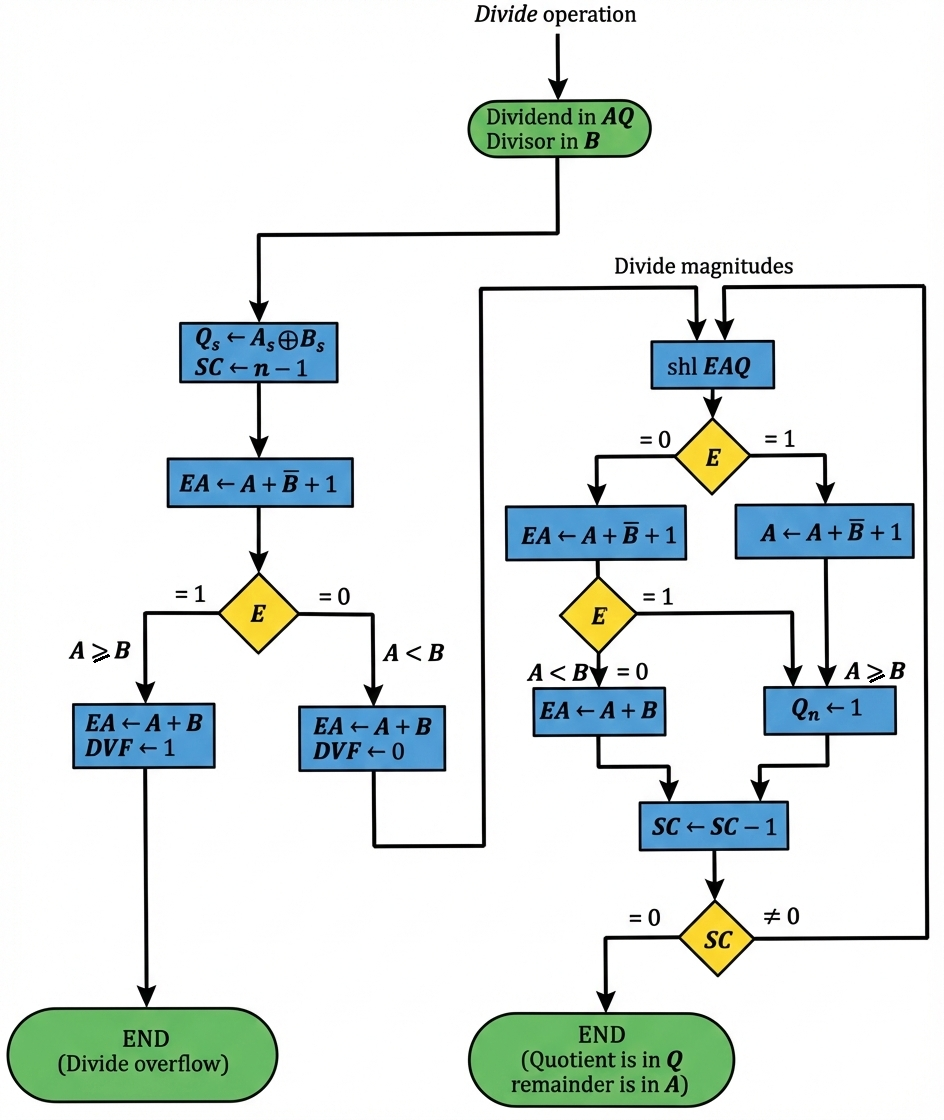
Detailed Magnitude Division Loop
The "Divide Magnitudes" section expands into the following iterative process:
- shl EAQ: Shift left the combined EAQ register
- Comparison: Check E bit after adding B̄ + 1
- If E = 0: A ≥ B, set Qn = 1, keep subtraction result
- If E = 1: A < B, set Qn = 0, restore by adding B
- SC ← SC - 1: Decrement sequence counter
- Check SC: If SC ≠ 0, repeat; if SC = 0, finish
DIVIDE(A, B):
E ← 0
Q ← 0
SC ← n - 1
// Overflow check
EA ← A + (NOT B) + 1
if E = 0 then
DVF ← 1
return OVERFLOW
// Restore and continue
A ← A + B
// Main division loop
while SC ≠ 0 do
Shift_Left(E, A, Q)
EA ← A + (NOT B) + 1
if E = 1 then
Q[0] ← 0
A ← A + B // Restore
else
Q[0] ← 1
end if
SC ← SC - 1
end while
return Q (quotient), A (remainder)
Timing Analysis
For an n-bit division operation:
- Number of iterations: n cycles
- Operations per cycle: 1 shift + 1 add/subtract + decision
- Total time complexity: O(n)
- Hardware complexity: Requires adder, shifter, and control logic
Other Division Algorithms
Beyond the restoring division algorithm, several alternative approaches exist for implementing division in hardware, each with unique trade-offs.
1. Non-Restoring Division
Key Improvement: Eliminates the restoration step, making the algorithm faster.
Instead of restoring the remainder after a negative result, the algorithm alternates between addition and subtraction based on the sign of the previous result.
1. If remainder ≥ 0: Shift left, subtract divisor
2. If remainder < 0: Shift left, add divisor
3. Quotient bit: 1 if remainder ≥ 0, else 0
4. Final adjustment if remainder is negative
Advantage: Saves one clock cycle per iteration when restoration would be needed
Disadvantage: Slightly more complex control logic
2. Two's Complement Division
Handles signed numbers directly without converting to magnitude form:
- Works with negative dividends and divisors
- Uses modified comparison and correction steps
- Eliminates need for separate sign handling
- Quotient and remainder signs follow mathematical rules
Rule: Sign of quotient = (sign of dividend) XOR (sign of divisor)
Rule: Sign of remainder = sign of dividend
3. SRT Division
Named after: Sweeney, Robertson, and Tocher
Uses a redundant number representation allowing quotient digits of {-1, 0, 1}:
- Can determine quotient digit by examining only few MSBs
- Reduces hardware complexity for high-speed division
- Used in many modern processors (e.g., Intel Pentium series)
- Requires quotient conversion at the end
4. Array Divider
- Unrolls the division loop into parallel hardware
- Each stage performs one subtraction/comparison
- Trades area for speed (O(1) time, O(n²) area)
- Very fast but expensive in terms of silicon area
- Used in specialized high-performance applications
5. Newton-Raphson Division
Iterative Approximation Method:
Computes 1/B using Newton-Raphson iteration, then multiplies by A:
X₀ = initial approximation of 1/B
Xᵢ₊₁ = Xᵢ(2 - B·Xᵢ) // Iterate until convergence
Result = A · Xₙ // Final quotient
- Converges quadratically (doubles precision each iteration)
- Requires fast multiplier hardware
- Better for floating-point division
- Used in modern FPUs (Floating Point Units)
6. Goldschmidt Division
- Simultaneously multiplies dividend and divisor by factors
- Converges divisor toward 1, making dividend approach quotient
- Highly parallelizable for pipelined architectures
- Used in AMD processors and GPUs
Comparison Table
| Algorithm | Speed | Hardware Cost | Best Use Case |
|---|---|---|---|
| Restoring | O(n) cycles | Low | Simple microcontrollers |
| Non-Restoring | O(n) cycles (faster) | Low-Medium | General purpose CPUs |
| SRT | O(n) cycles (efficient) | Medium | High-speed processors |
| Array Divider | O(1) cycle | Very High | Specialized applications |
| Newton-Raphson | O(log n) iterations | High | Floating-point units |
| Goldschmidt | O(log n) iterations | High | Pipelined FPUs |
Selecting the Right Algorithm
Design Considerations:
- Speed Requirements: How many clock cycles can you afford?
- Area Constraints: How much silicon area is available?
- Power Budget: Parallel solutions consume more power
- Data Type: Integer vs. floating-point division
- Precision Needs: Higher precision requires more iterations
- Frequency: How often is division performed?
Modern Implementation Trends
Contemporary processors often use hybrid approaches:
- Integer Division: SRT or non-restoring algorithms
- Floating-Point: Newton-Raphson or Goldschmidt with table lookup
- Low-Power Devices: Simple restoring with clock gating
- GPUs: Approximation methods with refinement
📚 Historical Note
The infamous Pentium FDIV bug (1994) was caused by an error in the lookup table used for SRT division. Five entries out of 1066 were incorrect, leading to rare but significant floating-point division errors. This incident cost Intel $475 million and highlighted the critical importance of verification in division hardware.