🎯 What is Decimal Division?
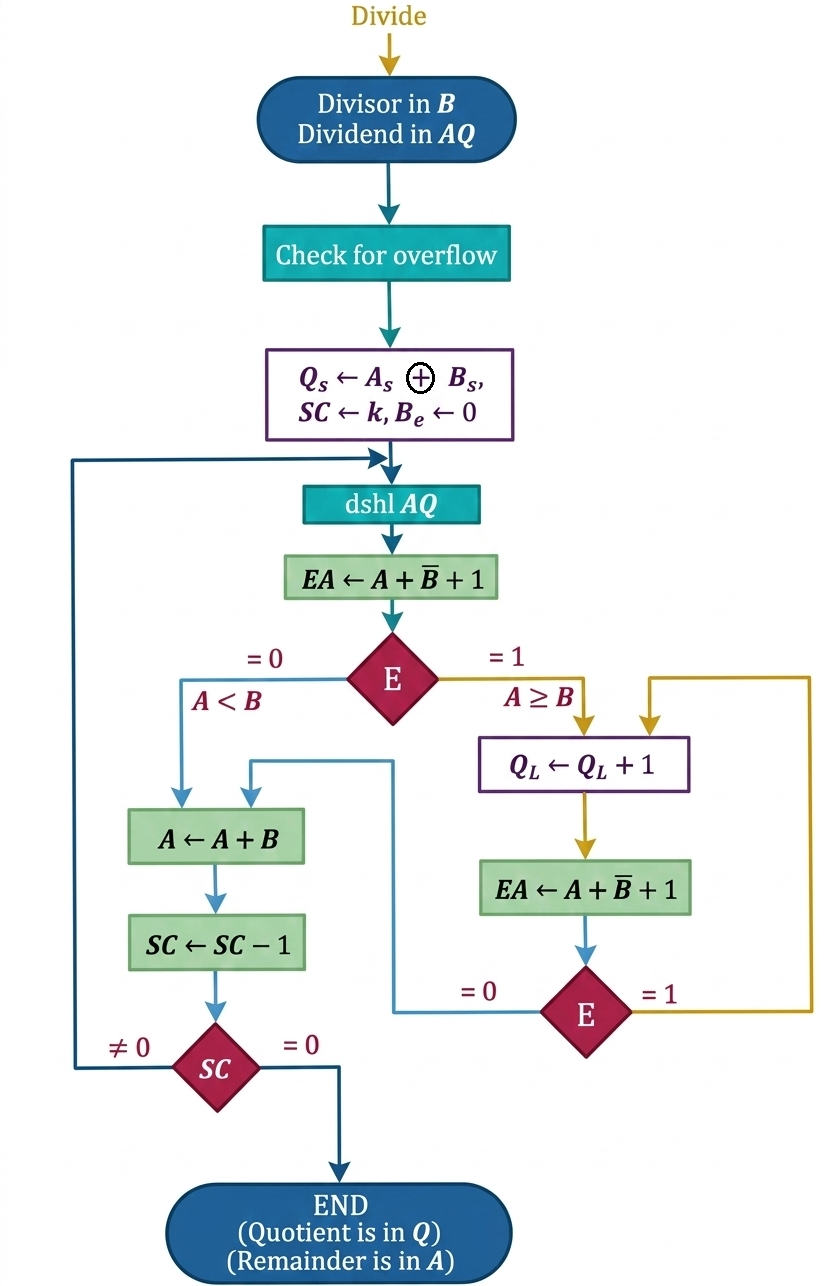
Decimal division is similar to binary division, but operates in base-10 (digits 0-9). The process involves repeated subtraction and shifting, where you subtract the divisor as many times as possible until a negative remainder results.
💡 Key Concept: The remainder is restored by adding back the divisor when subtraction results in a negative value. The digit representing the number of subtractions excludes the one that caused the negative remainder.
📋 The Algorithm
Step-by-Step Process:
1
Initialize: Place dividend in register AQ, divisor in register B. Set SC (step counter) to k.
2
Shift Left: Shift AQ left with most significant digit placed in Ae.
3
Subtract: Perform A ← A - B (subtract divisor from partial remainder).
4
Check Sign: If A < B (negative result), restore by A ← A + B and set QL = 0. Otherwise, set QL ← QL + 1.
5
Decrement: Decrease SC by 1. If SC ≠ 0, repeat from step 2.
6
Complete: Quotient is in Q, remainder is in A.
🔄 Flowchart Overview
🎮 Interactive Demo
Try it yourself! Enter a dividend and divisor to see the result:
📝 Example Walkthrough
Example: Divide decimal numbers
Process:
- The partial remainder and quotient bits are shifted left
- The process repeats k times to form k quotient digits
- The remainder is found in register A
- Quotient digits are accumulated in register Q
⚠️ Important: When the result is negative (A < B), the divisor is added back to restore the partial remainder, and QL stays at 0. The quotient digit equals the number of times divisor was subtracted from the dividend.