📚 Overview
BCD subtraction uses the complements method to convert subtraction operations into addition. Instead of directly computing A - B, we calculate A + (Complement of B). This elegant approach allows the same hardware used for BCD addition to also perform subtraction!
🔄 The 4-Step Principle
9's Complement
Subtract each digit of B from 9 to get the 9's complement
10's Complement
Add 1 to the 9's complement to get the 10's complement
Perform Addition
Add A to the 10's complement of B
Handle Result
Apply BCD correction and manage end carry to get final result
🎮 Interactive BCD Complement Calculator
Enter a digit and click Calculate
⚙️ Mode Control Circuit
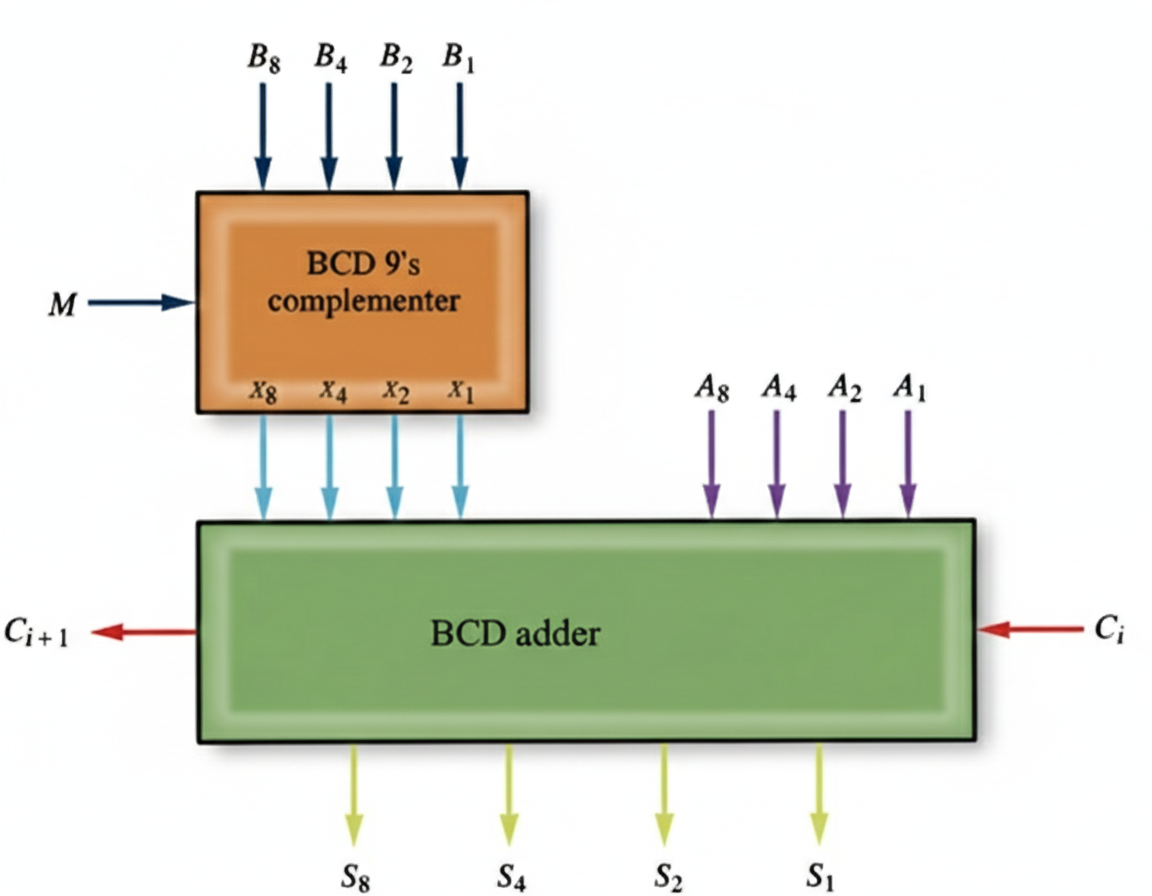
The BCD adder/subtractor uses a Mode signal (M) to switch between addition and subtraction:
📐 Input Logic Equations
These Boolean equations define how the subtrahend B is transformed based on the mode control M:
| Input Bit | Boolean Equation | Description |
|---|---|---|
| x₁ | x₁ = B₁M' + B₁'M |
XOR function - inverts B₁ when M=1 |
| x₂ | x₂ = B₂ |
Passes through unchanged |
| x₄ | x₄ = B₄M' + (B₄B₂ + B₄B₂')M |
Depends on lower-order bits for complement |
| x₈ | x₈ = B₈M' + B₈'B₄'B₂'M |
MSB logic considering all bits |
🔍 Implementation Details
The complete subtraction workflow:
1. Input B → Complement Generator (M=1)
2. Generate x₈, x₄, x₂, x₁ using logic equations
3. Feed x values to BCD Adder with minuend A
4. Set initial carry Cᵢₙ = 1 for LSD stage
5. This adds '1' converting 9's comp → 10's comp
6. BCD Adder handles correction and produces result
Key Insight: The same BCD adder circuit performs both addition and subtraction by simply controlling the input transformation and initial carry!