🎯 What is Associative Memory?
Associative Memory, also known as Content Addressable Memory (CAM), is a specialized memory storage system where data is accessed by its content rather than by a specific address or location. Unlike conventional memory that requires sequential searching, associative memory enables parallel searches across all stored data simultaneously.
Content-Based Search
Search by data content, not address
Parallel Processing
All entries checked simultaneously
Fast Retrieval
Minimal access time
Flexible Matching
Partial or complete matches
🏗️ Hardware Organization
The associative memory consists of an array of memory cells with built-in logic circuits for parallel comparison.
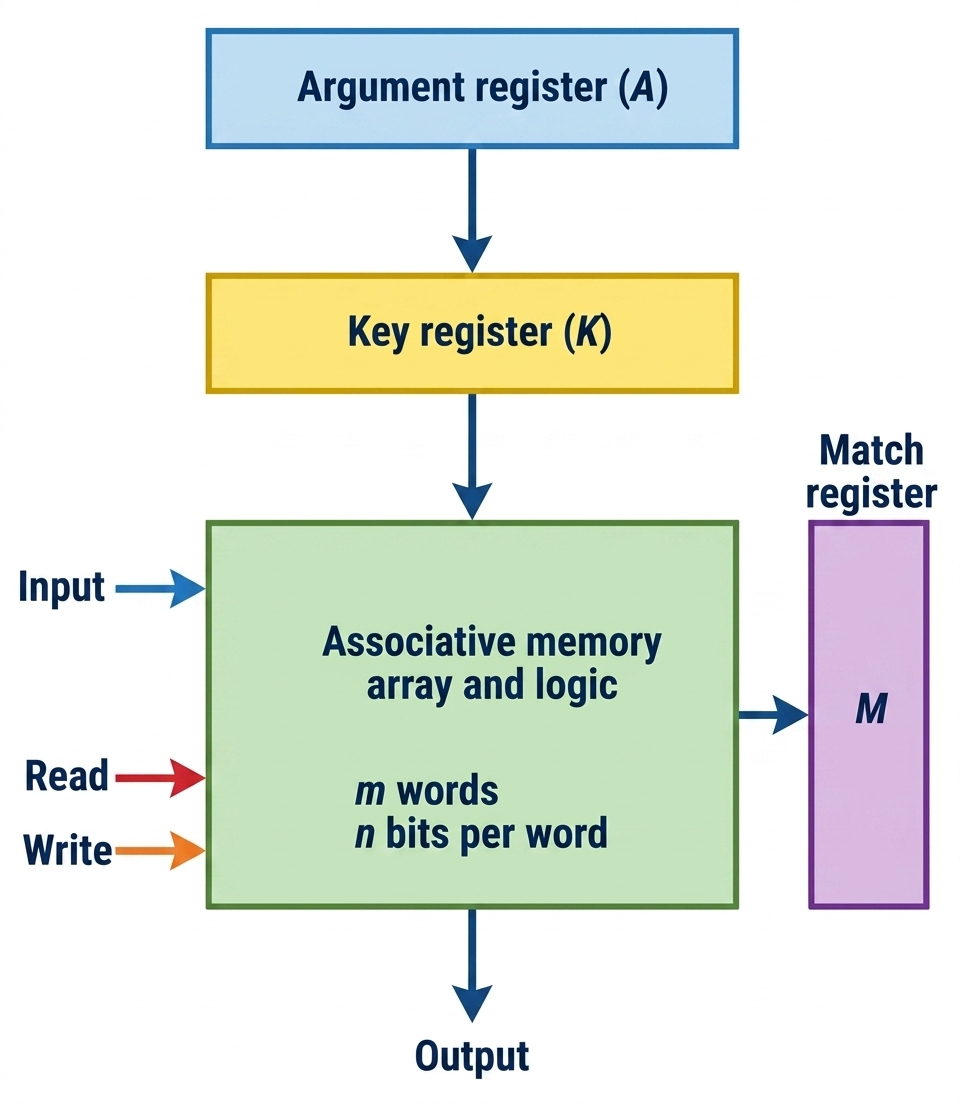
Key Components:
📝 Argument Register (A)
Holds the word or data to be searched
🔑 Key Register (K)
Specifies which bits should be compared
🧠 Memory Array
Stores words with m bits per word
✅ Match Register (M)
Indicates which words matched
🔧 Memory Operations
1. Read Operation
When a word in memory matches the unmasked argument bits, all matched words are read out sequentially. If multiple words match, the match register identifies them one at a time.
2. Write Operation
Writing can occur in different forms:
- Sequential Write: Address each location sequentially
- Random Write: Decode address as in standard RAM
- Content-Based Write: Find specific content and write to first match
3. Tag Register for Management
A tag register can specify active/inactive words, with positions for new word insertion. Deleted words become inactive, and their tag bits are masked with K for searching only active words.
🧩 Cell Structure of Associative Memory
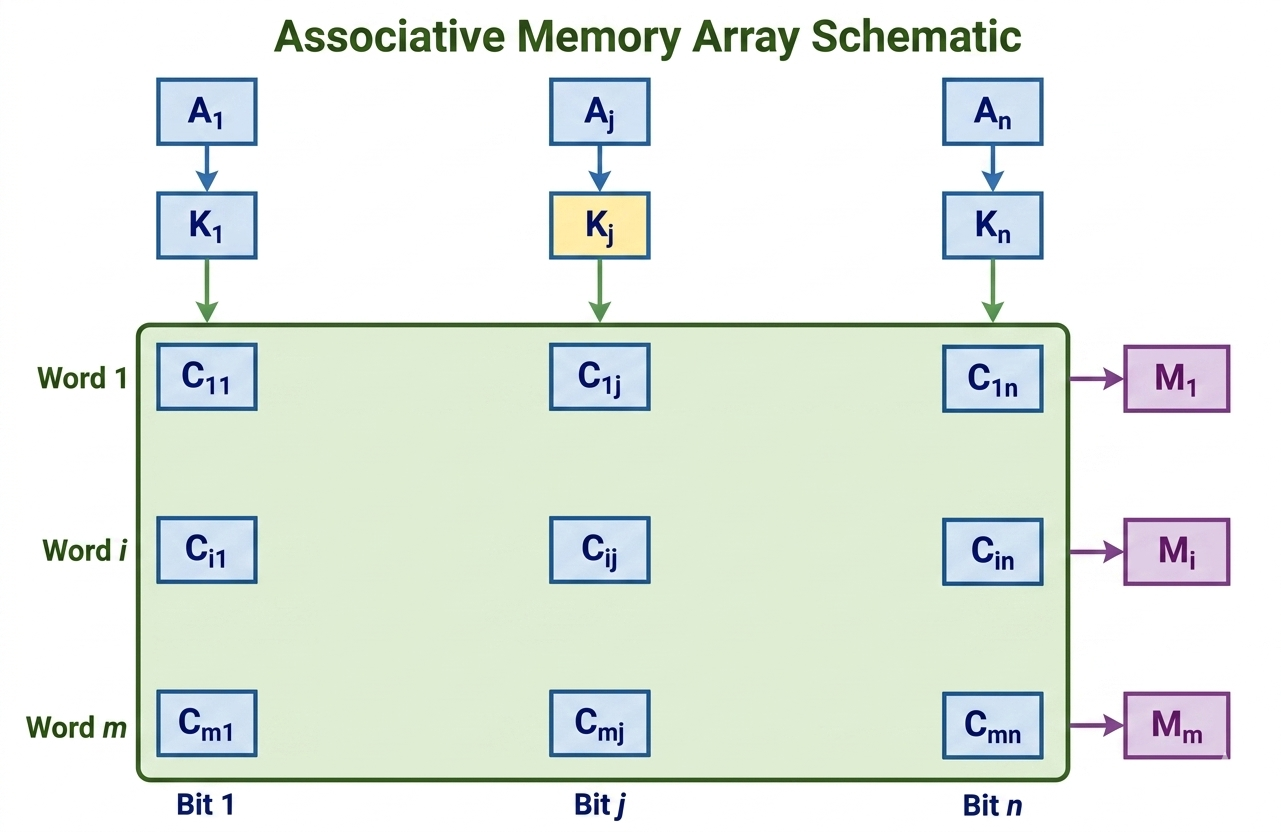
The matching process for each word is based on a comparison algorithm derived from Boolean logic:
- Parallel Comparison: Unlike standard RAM, which searches by address, associative memory compares the argument (A) against all words in the array simultaneously.
- Bit-Level Logic: For each word i, the hardware checks every bit j. The comparison only matters if the key bit Kj is enabled (set to 1). A "match" for a single word occurs only if all unmasked bits in that word exactly match the corresponding bits in the Argument Register.
- Setting the Match Bit (Mi):If word i matches the search criteria, the corresponding bit Mi in the Match Register is set to 1. If there is even one discrepancy in the unmasked bits, Mi is cleared to 0.
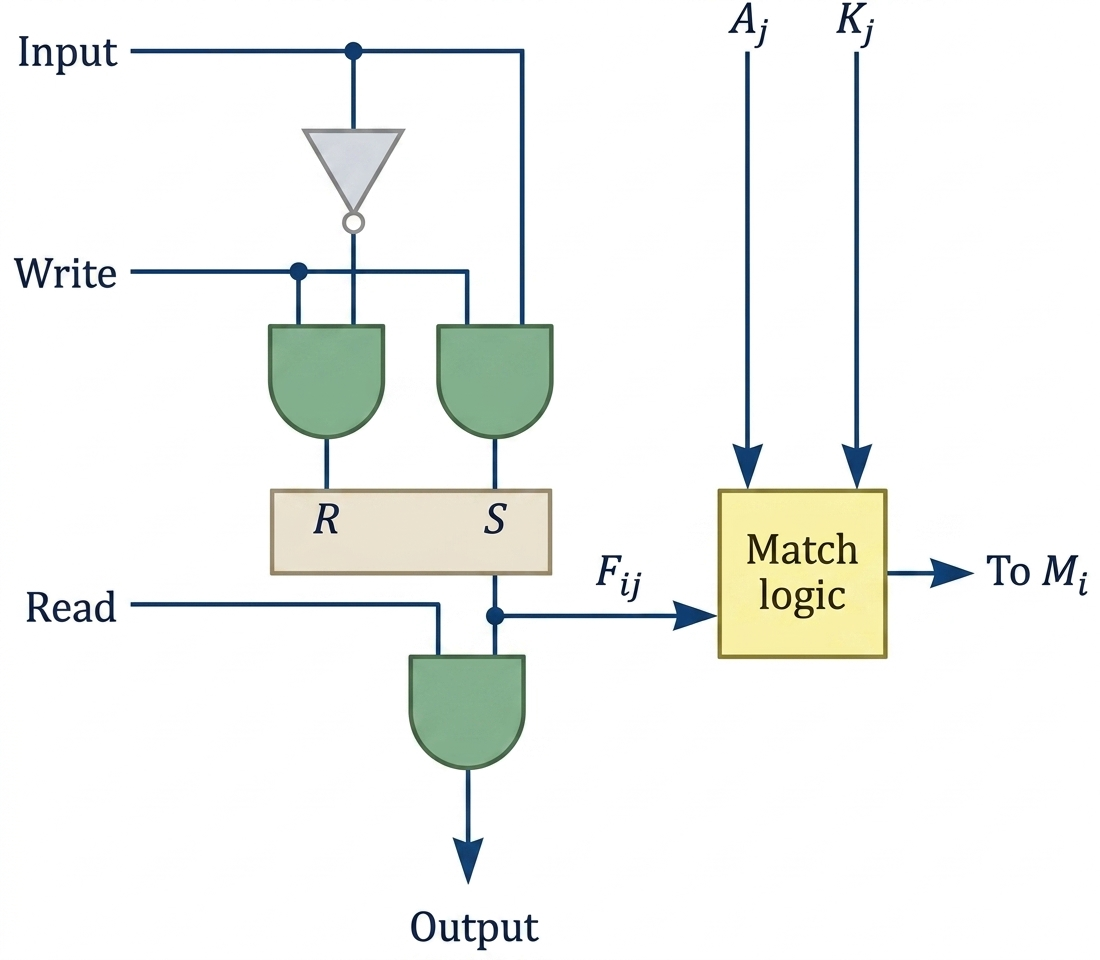
🧬 Internal Organization of Cell Cij
- Storage (Fij): Uses an RS flip-flop as the core storage element for a single bit.
- Writing: When the Write line is high, the Input bit is steered to the S or R terminals, updating the flip-flop.
- Reading: When the Read line is high, an AND gate outputs the current state of Fij to the Output line.
- Matching: The Match Logic compares the stored bit (Fij) with the argument bit (Aj).
- Masking: The Key bit (Kj) determines if this specific cell's match result is passed to the decision logic for the match register (Mi).
🧮 Match Logic
The matching process for each word is based on a comparison algorithm derived from Boolean logic
- Basic Bit Equality (xj): The first step is comparing an individual bit of the input argument (Aj) with the bit stored in the memory cell (Fij). Two bits are considered a match if they are both 1 or both 0. This is represented by the Boolean function:
xj = Aj Fij + Aj' Fij'If xj = 1, the bits match; if xj = 0, they do not
- The Role of the Key Bit (Kj): In associative memory, we often want to search only specific parts of a word (masking). This is handled by the Key Register.
- If Kj = 1: The bit in that position is important. The comparison xj must be performed.
- If Kj = 0: The bit position is "masked" or ignored. The logic should automatically treat this bit as a "match" so it doesn't interfere with the overall word result.
- Word Match Condition (Mi): A "match" for an entire word (Mi) only occurs if every single bit position either matches the input or is masked by the key. The logic uses an AND operation across all n bits in the word. If any unmasked bit fails to match, the AND operation results in 0, and Mi will be 0.
- The Complete Boolean Expression: Combining the equality logic and the masking logic, the final match signal for word $i$ is expressed as:
Mi = ∏ j=1 n (AjFij + A'jF'ij + K'j)
🎮 Interactive Match Demo
Click memory cells to toggle their state:
Argument: 101 11100 (checking first 3 bits only)
✨ Key Advantages
Speed
Parallel searching reduces access time significantly
Efficiency
No sequential scanning required
Flexibility
Partial matching with key register
Database Applications
Ideal for table lookups and searches
🚀 Applications
💳 Cache Memory
Fast data lookup in CPU caches
🌐 Network Routing
IP address lookup tables
🗄️ Database Systems
Quick record retrieval
🔐 Security
Pattern matching and filtering