📚 Assembly Language Multiplication
Interactive Guide to Binary Multiplication Programming
🎯 Objective
Understand the step-by-step process of multiplying two positive binary numbers using an assembly-level algorithm.
⚡ Key Concepts
🎯 X - Multiplicand
The number to be multiplied. This value remains relatively stable during the process but gets shifted left as we progress through each bit.
🔢 Y - Multiplier
The number by which we multiply. Its bits are examined one by one to determine whether to add the multiplicand to the partial product.
✨ P - Product
The result formed during the multiplication process. Starts at zero and accumulates the final result through repeated additions.
🧠 Core Principle
This program performs multiplication using bit manipulation and repeated addition, simulating manual binary multiplication efficiently for early computers without hardware multiplication units.
🔄 Flowchart
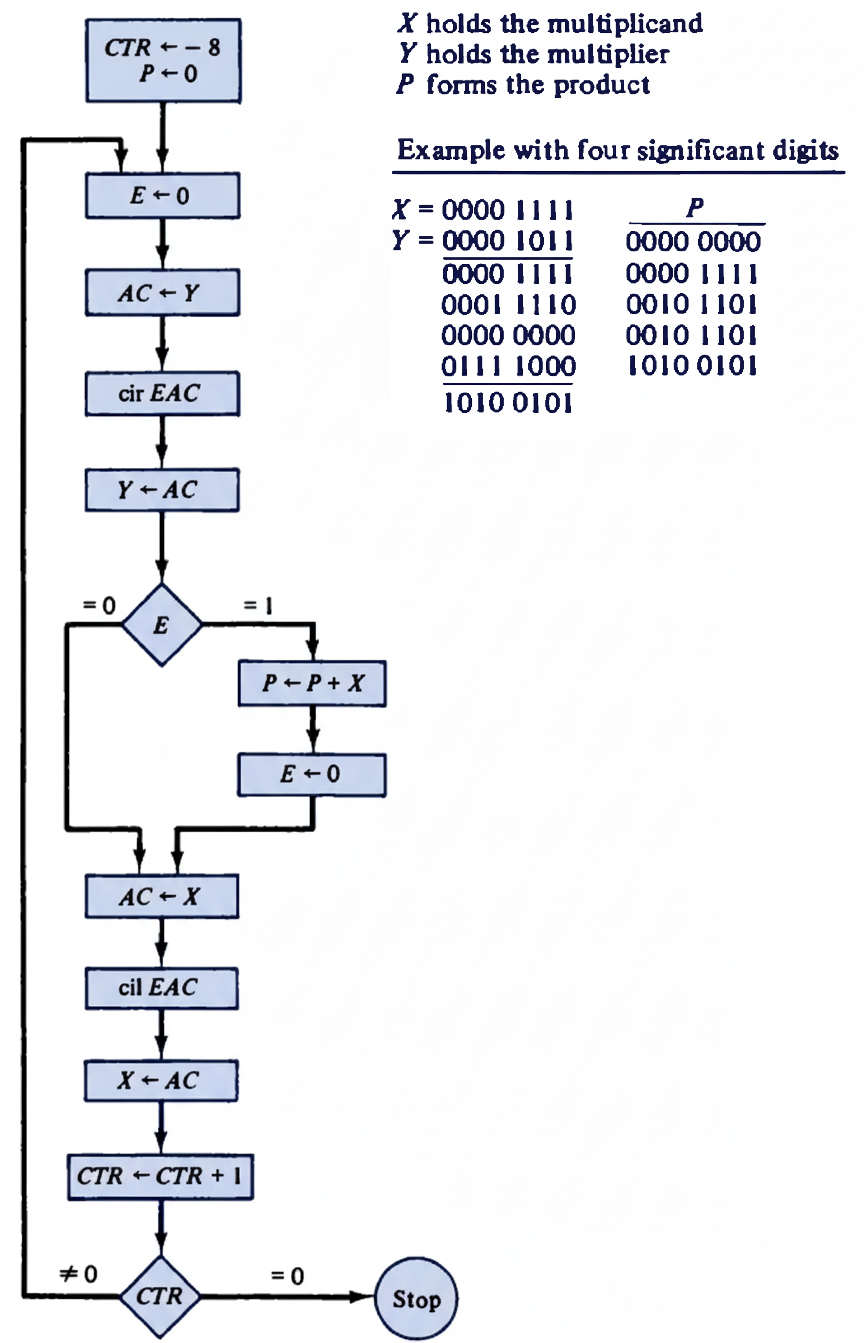
🧠 Analysis
• Set counter CTR ← 8 (handling 8 bits)
• Initialize P ← 0 (Product starts at zero)
• Initialize E ← 0 (Extra bit)
• AC ← Y (Load multiplier into accumulator)
• Perform cir EAC (Shift E with AC right as a group, so least significant bit of AC is move to E)
• Y ← AC (Bit shifted out of Y is stored in E)
• If E == 1: Add X (Multiplicand) to P (Product)
• Else: Skip addition step
• Reset E ← 0
• AC ← X, then perform cil EAC
• X ← AC (Update shifted multiplicand)
• CTR ← CTR - 1
• If CTR ≠ 0: Repeat from step 2
• Else: Halt program (multiplication complete)
💾 Assembly Program Code
Complete assembly listing with detailed comments:
LOP, CLE ; Clear E (Extra bit register)
LDA Y ; Load multiplier into AC
CIR ; Circular shift right
STA Y ; Store shifted multiplier
SZE ; Check if E == 0
BUN ONE ; Branch to ONE if E == 1
BUN ZRO ; Branch to ZRO if E == 0
ONE, LDA X ; Load multiplicand into AC
ADD P ; Add partial product to AC
STA P ; Store result back into P
CLE ; Clear E register again
ZRO, LDA X ; Load multiplicand
CIL ; Circular shift left
STA X ; Store shifted multiplicand
ISZ CTR ; Increment counter
BUN LOP ; Repeat loop if counter ≠ 0
HLT ; Halt program when done
CTR, DEC -8 ; Initialize counter with -8
X, HEX 000F ; Multiplicand storage
Y, HEX 000B ; Multiplier storage
P, HEX 0 ; Product storage
END ; End of program
🔧 Instruction Breakdown
CLE - Clear E
Clears the extra bit register E to 0, preparing for the next operation.
CIR/CIL - Circular Shifts
CIR shifts right, CIL shifts left. These preserve bits by moving them in a circular fashion.
SZE - Skip if Zero
Tests if the E register is zero and skips the next instruction if true.
ISZ - Increment and Skip
Increments the counter and skips the next instruction if the result is zero.
🧮 Binary Multiplication Example
Let's trace through multiplying 15 (1111₂) by 11 (1011₂):
Initial Values:
| Step | X (Multiplicand) | Y (Multiplier) | P (Product) | E Bit | Action |
|---|---|---|---|---|---|
| Initial | 0000 1111 | 0000 1011 | 0000 0000 | 0 | Setup |
| 1 | 0001 1110 | 0000 0101 | 0000 1111 | 1 | Add X to P |
| 2 | 0011 1100 | 0000 0010 | 0010 1001 | 1 | Add X to P |
| 3 | 0111 1000 | 0000 0001 | 0010 1001 | 0 | Skip addition |
| 4 | 1111 0000 | 0000 0000 | 1010 0101 | 1 | Add X to P |
✅ Final Result
15 × 11 = 165
Binary: 1010 0101₂ = 165₁₀