⚡

Instruction Pipeline

Master the concepts of instruction pipelining with interactive visualizations and detailed explanations

💾
2-4
Pipeline Segments
⚡
3
Types of Conflicts
⏱️
↑
Performance Boost

🎯 Interactive Pipeline Visualization

Cycle: 0
Instruction 0123456789
🎓

Introduction to Pipelining

›

Instruction Pipelining is a fundamental technique in modern processor design that dramatically improves performance by allowing multiple instructions to execute concurrently.

🔑 Key Concept

Pipelining decomposes instruction execution into sub-operations, with each sub-operation executed in a dedicated segment. This allows several computations to progress simultaneously through different pipeline stages.

✅ Benefits

  • Increased instruction throughput
  • Better CPU utilization
  • Improved overall performance
  • Concurrent execution of multiple instructions

⚠️ Challenges

  • Pipeline conflicts and hazards
  • Data dependencies between instructions
  • Branch prediction complexities
  • Resource allocation conflicts
⚙️

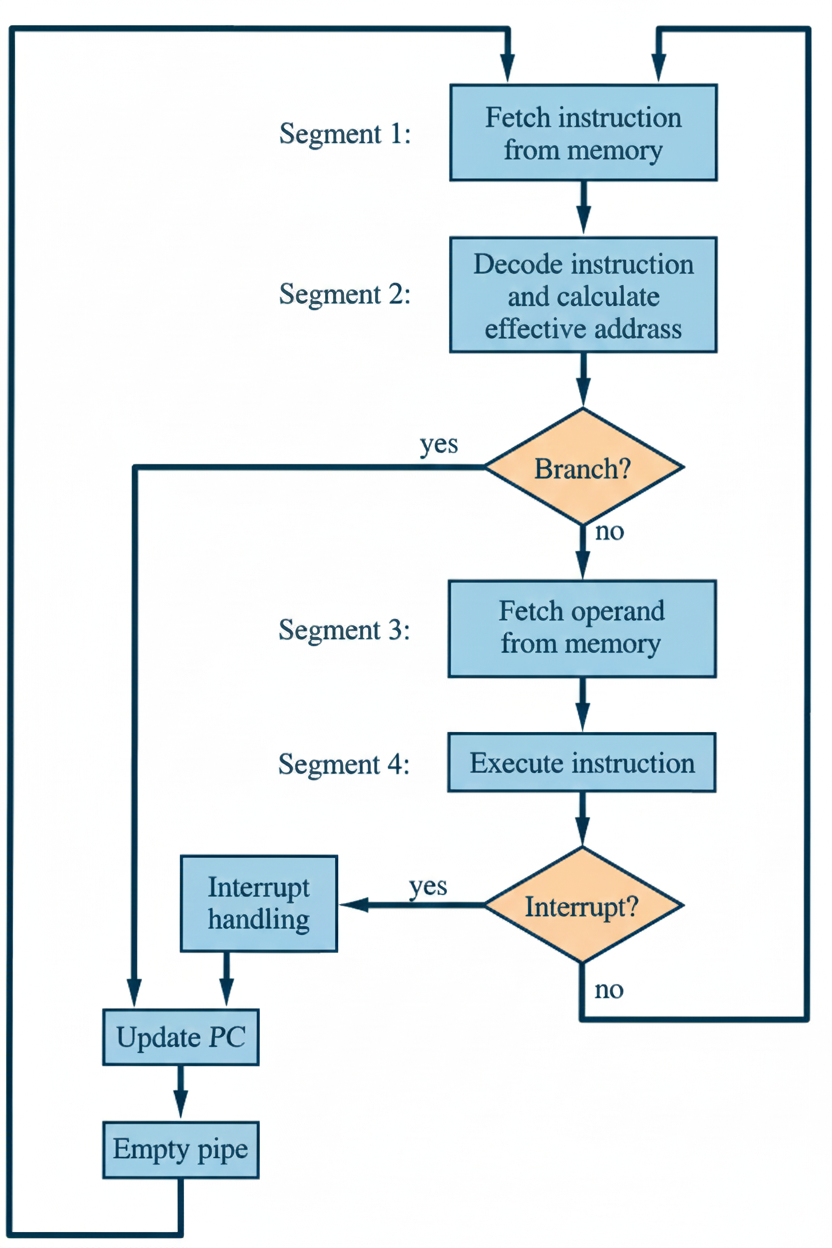
Four-Segment Pipeline Structure

›

The most common instruction pipeline model uses four segments, each handling a specific phase of instruction execution.

1️⃣

FI - Fetch Instruction

Retrieve the next instruction from memory using the program counter (PC).

2️⃣

DA - Decode & Address

Decode the instruction and calculate the effective memory address for operands.

3️⃣

FO - Fetch Operand

Retrieve the required operand from memory or registers.

4️⃣

EI - Execute Instruction

Execute the instruction operation and write results back to registers or memory.

Flow diagram of instruction pipeline
Pipeline Overlap:
  • Up to four suboperations in the instruction cycle can overlap.
  • Up to four different instructions can be processed simultaneously.

✅ program control instruction

  • Pending operations in the last two segments are completed.
  • Instruction buffer is cleared.
  • Pipeline restarts from the new address stored in the program counter.

⚠️ Interrupt request

  • The pipeline is emptied.
  • Execution starts again from a new instruction address.
⚠️

Pipeline Conflicts & Hazards

›

Pipeline conflicts occur when instructions cannot execute in the desired sequence. There are three main types:

1. 🔧 Resource Conflicts (Structural Hazards)

Multiple instructions compete for the same hardware resource simultaneously.

Example: Two instructions need to access memory at the same time, but only one memory port is available.

2. 📊 Data Dependencies (Data Hazards)

An instruction requires results from a previous instruction still in the pipeline.

RAW
Read-After-Write
Instruction B tries to read a register before instruction A has written to it.
WAR
Write-After-Read
Instruction B tries to write to a register before instruction A has read from it.
WAW
Write-After-Write
Two instructions try to write to the same register in the wrong order.

3. 🔀 Branch Difficulties (Control Hazards)

Branch instructions change execution flow, potentially invalidating fetched instructions.

Example: Instructions after a conditional branch are fetched before the branch condition is evaluated, leading to potential pipeline flushes.

✅

Handling Pipeline Conflicts

›

⚡ Data Dependency Solutions

Forwarding / Bypassing

Execute instruction after branch regardless of outcome (delay slot). Compiler must fill the slot wisely.

Branch Prediction

Predict branch outcome to minimize pipeline stalls. Modern CPUs achieve 95%+ accuracy.

Branch Target Buffer

Cache storing target addresses of previous branches for faster prediction and fetching.

💡 Delayed Branch Example

1. BRANCH if condition then goto label
2. ADD R1, R2 ← Delay slot (always executes)
3. label: LOAD R3

The ADD instruction executes before the branch decision is made, keeping the pipeline busy and avoiding a stall cycle.